
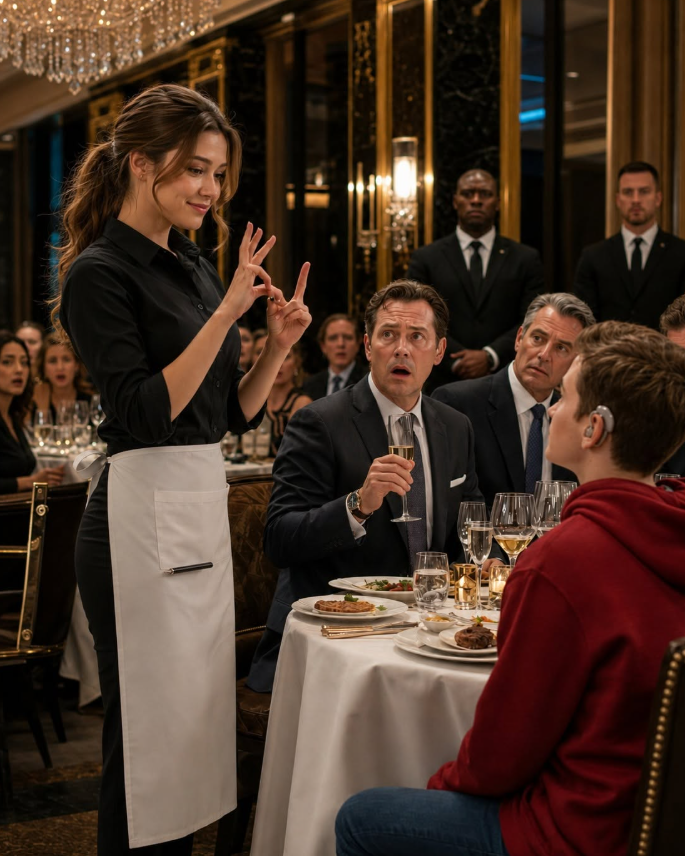
For one long second, I forgot how to breathe.
Ethan’s hands stayed lifted between us.
Thank you.
That was all he had signed.
But the words landed inside me like something much larger. Like a window opening in a room that had been locked for years.
Across the table, Christopher Hale’s smile had vanished so completely it was hard to believe it had ever been there.
His three friends glanced between us, unsure whether they were supposed to laugh again. None of them did. Their amusement had collapsed into the awkward silence of men who had suddenly realized the joke was not funny, and maybe never had been.
I swallowed, then signed back to Ethan.
You’re welcome. Would you like me to sign while I take your order?
Ethan blinked.
His eyes shone, not with tears exactly, but with the fragile surprise of someone receiving kindness in a place where he expected none.
He nodded.
Yes, please.
I picked up my notepad again, though my fingers trembled around the pen.
“What are you doing?” Christopher asked.
His voice was quiet now.
That made it worse.
A loud cruel man could be ignored by a room. A quiet powerful one could make everyone lean closer without meaning to.
I turned toward him with the careful expression servers learn by necessity. Pleasant. Neutral. Soft enough to survive.
“I’m taking your son’s order, Mr. Hale.”
“My son can point at a menu.”
Ethan’s shoulders tightened.
I saw it. Christopher saw it too.
That was the worst part.
He knew exactly where his words landed.
I kept my eyes steady. “He can also order for himself.”
One of Christopher’s friends gave a low whistle under his breath, as if I had stepped into traffic.
Christopher leaned forward slightly.
“What did you say your name was?”
My manager, Mr. Bell, appeared near the wine station like he had been summoned by fear itself. His face was pale under the golden light.
“Mary,” Christopher repeated, reading my name tag before I could answer. “Mary Lin.”
My heart gave a small hard knock against my ribs.
“Yes, sir.”
He looked at me for a moment that stretched too long. Then he sat back and lifted his champagne glass.
“Fine,” he said. “Take his order. Since you’re so determined to perform.”
Ethan lowered his gaze again, but this time I noticed something different.
His hands were not clenched anymore.
I turned fully toward him, blocking out the table behind me as much as I could.
What would you like?
He looked down at the menu. His fingers moved slowly, careful and neat.
The salmon. No almonds, please. I’m allergic.
A cold ripple passed through me.
I turned to the kitchen ticket and wrote in block letters: SALMON. NO ALMONDS. ALLERGY.
Then I signed, I’ll make sure.
Ethan’s expression softened.
Thank you.
Christopher made a small sound in his throat. “He’s not a child.”
“No,” I said before I could stop myself. “He isn’t.”
The silence returned.
Mr. Bell’s eyes widened from across the room.
I thought, There goes my job.
But something strange happened.
Christopher did not shout. He did not demand my manager drag me outside. He only stared at me with a look I could not quite read.
It was not guilt.
Not yet.
It was more like recognition.
As though some small thing had shifted in his memory, and he hated that I had caused it.
I finished taking the table’s order and walked toward the kitchen on legs that felt borrowed.
The moment I pushed through the swinging doors, the noise swallowed me whole.
“Mary,” Mr. Bell hissed behind me.
I stopped beside the prep counter.
He marched up with his tie slightly crooked, his forehead shining. “Do you understand what you just did?”
“Yes.”
“Do you understand who that man is?”
“Yes.”
“Then why would you argue with him?”
I looked down at my order pad. My handwriting was darker than usual where I had pressed the pen too hard.
“Because his son is allergic to almonds,” I said. “And because he deserved to order dinner.”
Mr. Bell stared at me like basic decency was a foreign language.
“You are one complaint away from being unemployed.”
A bitter laugh almost escaped me.
One complaint.
One month’s rent.
One envelope under the door.
One powerful man’s mood standing between me and the street.
“I know,” I said quietly.
Something in my voice must have reached him, because his expression softened by half an inch. Then the kitchen printer shrieked, a cook shouted for garnish, and the moment disappeared.
“Just finish the table,” he said. “No more… speeches.”
I nodded.
But when I turned toward the service station, I found myself staring at my hands.
The last time I had signed that sentence—You are not embarrassing—had been to my little brother Leo in a hospital room that smelled like antiseptic and rain.
He had been eleven then.
Small for his age, all elbows and worried eyes.
The accident had not taken his hearing, but it had taken his voice for a while. Not physically, the doctors said. Emotionally. Trauma had closed something inside him, and no amount of pleading could open it.
So I learned sign language from library books, old videos, community classes I could barely afford, and a retired teacher named Mrs. Alvarez who refused to let me quit.
“Hands can be a home,” she had told me. “Build one carefully.”
For months, Leo and I lived there.
In that home made of signs.
Hungry?
Scared?
I’m here.
You are safe.
You are not alone.
Then one spring morning, while I was burning toast in our tiny kitchen, Leo had whispered my name.
Mary.
One word.
My whole universe.
I blinked hard and forced myself back into the present.
Table twelve needed champagne refilled.
Life did not pause for memories.
When I returned, Christopher’s friends had resumed talking, though their laughter was smaller now, more cautious. Ethan sat quietly at the end, his eyes following the conversation without joining it.
I poured champagne with steady hands.
“Mary.”
I looked up.
Christopher’s voice had changed again. Not kinder. Just lower.
“What did you sign to him?”
My throat tightened.
Ethan looked at me quickly.
I knew what Christopher expected. Fear. Apology. Maybe a lie.
I also knew Ethan was watching.
I set the bottle gently back into the ice bucket.
“I told him he was not embarrassing,” I said.
Christopher’s jaw moved once.
“And?”
I met his eyes.
“That you were.”
One of his friends coughed into his napkin.
Mr. Bell froze ten feet away with a tray of bread in his hands.
Christopher set his glass down.
Very slowly.
The crystal made a small, final sound against the table.
Ethan stared at me with his lips parted.
I expected anger.
I expected a raised voice, a snapped finger, a demand that I be removed.
Instead, Christopher looked at his son.
Really looked at him.
For the first time that night.
Ethan did not look away.
That seemed to unsettle Christopher more than my words had.
For several seconds, father and son faced each other across the length of the table. The space between them was filled with champagne, silverware, expensive flowers, and years of things neither of them knew how to say.
Then Christopher turned back to me.
“Bring the food,” he said.
I nodded and walked away before my courage could collapse.
In the kitchen, the chef had already called Ethan’s salmon.
“No almonds,” I reminded him.
He waved his tongs at me. “It’s on the ticket.”
“Separate pan?”
He looked annoyed. “Yes.”
“Clean utensils?”
“Mary.”
I held his gaze.
He sighed. “Clean utensils. Separate pan. No almonds. Go polish something before you climb inside the oven and cook it yourself.”
I almost smiled.
Almost.
When the entrees were ready, I carried Ethan’s plate separately. Not on the same tray as the almond-crusted trout ordered by one of Christopher’s friends. Not near any garnish that could cause doubt.
I set it down in front of him and signed quietly.
I checked with the chef. No almonds. Separate pan.
Ethan looked at the plate, then at me.
You believed me.
The words squeezed something behind my ribs.
Of course.
He gave the smallest smile.
It changed his whole face.
Not in a dramatic way. Nothing like a movie where sadness disappears all at once. His smile was hesitant, almost confused by its own presence, but it was real.
Christopher saw it.
I saw him see it.
And for the first time, his expression did not look angry.
It looked lost.
A hard problem, yes.
But not an ending.
My phone buzzed.
Leo.
I wiped my face and answered.
“Hey,” I said, trying to sound normal.
“You sound weird,” he said immediately.
At sixteen, his voice was still softer than most boys his age, but every word was a miracle to me.
“I’m at work.”
“You always sound tired at work. This is different weird.”
I laughed, sniffling.
“Something happened.”
“Bad something?”
I looked at the receipt.
“No,” I said. “I think… good something.”
There was a pause.
“Mary.”
He only said my name, but I heard everything inside it. The worry. The years of watching me pretend bills were not heavy. The guilt he carried even though none of it was his fault.
“We’re okay,” I said.
“Are you lying?”
“Not tonight.”
Another pause.
Then, very quietly, he said, “Good.”
I closed my eyes.
“Leo?”
“Yeah?”
“Do you remember Mrs. Alvarez?”
“The sign language lady who smelled like peppermint?”
“That’s the one.”
“Yeah.”
I leaned against the sink.
“I used it tonight. What she taught us.”
“For a customer?”
“For someone who needed it.”
Leo was quiet.
Then he said, “Hands can be a home.”
My heart squeezed.
“You remember that?”
“I remember everything from then,” he said.
The words were gentle, but they opened a door in me I had not touched in a long time.
“Not everything,” I whispered.
“What?”
“Nothing. I’ll be home soon.”
When my shift finally ended, the city was cold and shining. Rain had fallen while I worked, leaving the streets slick with reflections. The skyscrapers rose above me like glass cliffs, their windows glowing with lives I would never know.
I walked to the bus stop with my coat pulled tight, one hand resting over my purse as though the receipt might disappear.
That was when a black car rolled to the curb.
My first instinct was fear.
Then the back window lowered.
Ethan Hale sat inside.
Alone.
He lifted one hand in a small wave.
I stepped back slightly. “Ethan?”
He opened the door and climbed out before the driver could help him. Under the streetlamp, he looked younger than he had in the restaurant. Less like a billionaire’s son. More like a boy carrying a box too heavy for his arms.
He signed, I’m sorry if this is strange.
“It’s okay,” I said, signing as I spoke. “Is everything all right?”
He looked toward the car, then back at me.
My father wants to speak with you tomorrow.
My stomach tightened.
“About tonight?”
Ethan nodded.
And about my mother.
The rainwater hissed softly beneath passing tires.
“Why me?”
Ethan looked down.
Because when you translated, he listened.
I did not know what to say.
A bus approached in the distance, headlights glowing through the mist.
Ethan reached into the pocket of his hoodie and pulled out a folded piece of paper.
He hesitated before handing it to me.
I took it carefully.
“What is this?”
He signed, I found it in my father’s coat pocket after dinner.
I froze.
“You took it?”
Borrowed, he signed, then winced. I know. I shouldn’t have.
I unfolded the paper.
It was old.
Not ancient, but worn at the edges, softened by years of being handled. The page had been torn from a sketchbook. On it was a drawing of a building with sweeping windows, wide ramps, open courtyards, and signs marked in both written words and hand symbols.
At the bottom, in delicate handwriting, was a title:
The Hale Center for Listening Hands.
Beneath that, a note.
For Ethan, so the world will meet him halfway.
My breath caught.
“Your mother drew this?”
Ethan nodded.
His eyes were bright.
I found more once. Years ago. A locked room in our house. Blueprints. Letters. Her journals, maybe. But my father moved everything after he caught me.
I stared at the sketch.
A center.
For listening hands.
For Ethan.
The bus pulled up beside us, brakes sighing.
The doors opened.
I did not move.
Ethan’s hands trembled as he signed again.
Mary, I don’t think my mother’s dream disappeared. I think my father buried it.
A cold breeze moved between us, lifting the edge of the paper.
I looked down at the drawing again.
That was when I noticed something written faintly on the back, almost hidden where the page had been folded.
Not a note.
A name.
Mary Lin.
My name.
Written in the same delicate handwriting as the title.
The bus driver called, “You getting on or not?”
I could barely hear him.
Because underneath my name were four words that made the whole city tilt beneath my feet.
Find her when he’s ready
