
A younger me, maybe seven or eight, with blunt-cut brown hair and a missing front tooth, smiling at the camera while wearing a yellow sweater I had no memory of owning.
Beside the photo was another picture: the tall man sitting across from me now, younger but unmistakable, standing with his arm around a woman who could have been my reflection. Same dark eyes. Same narrow chin. Same small scar above the left eyebrow.
I touched my own eyebrow without thinking.
The man noticed.
His gaze was fixed, controlled, but there was something wounded beneath it, something old and carefully buried.
“My sister wore this the night she was murdered,” he said again, quieter this time.
The word murdered landed between us like a stone dropped into deep water.
Lucia sat pressed against his side, bundled in my coat, her cheeks beginning to regain color. She looked from him to me and back again.
“Daddy,” she whispered, “is she Aunt Clare?”
The man’s jaw tightened.
“No,” he said, but there was no certainty in it.
I forced myself to breathe.
“My name is Clare Hartwell,” I said. “I don’t know who your sister was. I don’t know why that locket has my picture in it. I don’t even know how it got into my coat.”
Lucia looked down, ashamed.
“I put it there.”
Every adult in the SUV turned toward her.
Her father’s voice softened. “Lucia.”
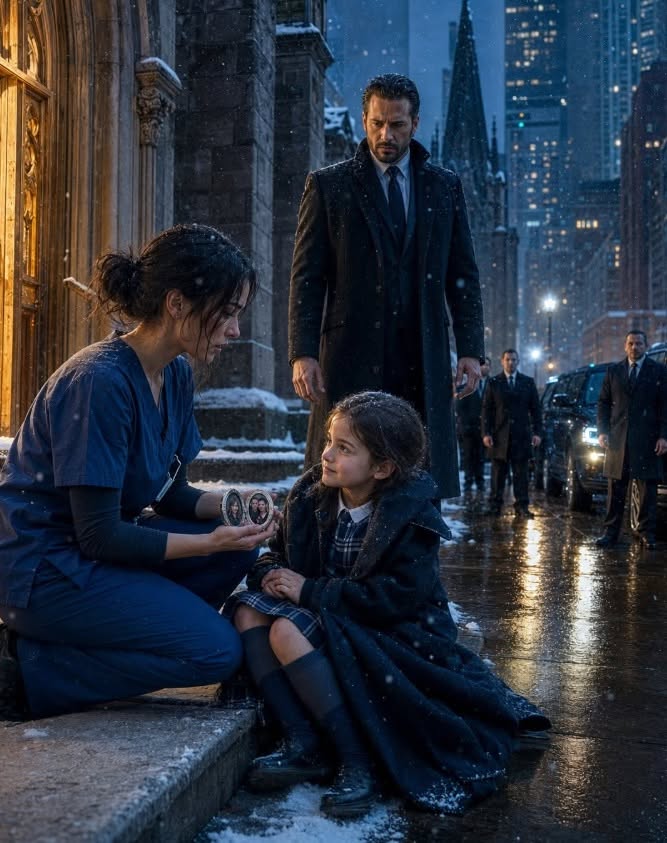
“I’m sorry,” she said, clutching the locket in both hands. “Nonna gave it to me. She told me if I ever got lost, I should find a woman with sad eyes and a nurse badge.”
My skin went cold for reasons that had nothing to do with winter.
“A woman with sad eyes?” I repeated.
Lucia nodded. “She said she might not remember, but she would help me anyway.”
The man closed his eyes.
For the first time since he had appeared on the church steps, he looked less like a feared man and more like someone who had just heard a ghost speak through his child.
“Your grandmother told you this?” he asked.
Lucia nodded again. “She said not to tell you unless I had to.”
The SUV slowed at a red light. Outside, a man in a knit cap hurried past with his collar up, his breath turning silver in the air. Life continued beyond the tinted windows. People walked. Cars honked. A bus sighed at the curb.
Inside, my life was being rewritten by strangers.
“Who are you?” I asked him.
He looked at me for a long second.
“Matteo Bellandi.”
I knew the name.
Everyone in Chicago knew the name, though most people pretended not to. It passed through emergency rooms in whispers, appeared in news reports without proof attached, lived in the nervous pauses of police officers and city officials. Bellandi meant old money, private restaurants, closed doors, men who spoke softly and were obeyed.
“You’re Lucia’s father,” I said.
“Yes.”
“And your sister was named Clare Hartwell?”
His mouth hardened at the name.
“Clara Bellandi,” he said. “But when she left home, she used Hartwell. Our mother’s maiden name.”
My heartbeat stumbled.
“My adoptive parents were named Hartwell,” I said.
Matteo went very still.
“What were their first names?”
“Eleanor and James.”
Something moved across his face. Recognition. Pain. Anger held on a tight leash.
He looked out the window and said something low in Italian. I didn’t understand the words, but I understood grief in any language.
“My sister trusted a nurse named Eleanor,” he said. “After she ran.”
I pressed my fingers against the locket until its edges bit into my palm.
“I was adopted when I was nine,” I said. “Before that, there are records. Foster homes. A fire. A hospital stay. I don’t remember much before that.”
“What hospital?”
“I don’t know. I was told I had a fever. Trauma. They said memory loss was normal.”
Matteo’s eyes returned to mine.
“Who told you?”
“My parents.”
“The Hartwells?”
I nodded.
“They’re dead?”
The question sounded too sharp.
“My mother died when I was nineteen,” I said. “My father three years later.”
A silence followed. Not empty, but crowded.
Lucia leaned closer to me across the seat. “Are you scared?”
“Yes,” I said, because lying to children had always felt cruel. “A little.”
She looked at her father. “Daddy won’t let anyone hurt you.”
Matteo’s expression changed, not because he disagreed, but because the promise had already cost him something.
“We’re not going to my apartment, are we?” I asked.
“No.”
“Then where?”
“A place where people cannot watch you through your windows.”
I almost laughed, but it came out as a dry breath. “That’s supposed to comfort me?”
“No,” he said. “It is supposed to keep you alive.”
The SUV turned off the main road into a quieter neighborhood where old brick buildings stood behind wrought-iron gates. Snow gathered on stone lions and bare branches. We pulled into an underground garage beneath a building that looked less like a home and more like a fortress pretending to be one.
The men got out first.
Matteo carried Lucia, though she protested that she could walk. He ignored her with the practiced ease of a father accustomed to her pride. I followed, still in my thin scrubs, shaking so hard I could barely feel my feet.
One of the guards noticed and took off his own wool coat.
Before he could hand it to me, Matteo stopped him with a glance.
Then he removed his own coat and put it around my shoulders.
It was warm from his body and smelled faintly of cedar and winter air.
“I don’t want favors,” I said.
“It isn’t a favor.”
“What is it?”
His answer came after a pause.
“An apology I do not know how to make yet.”
The elevator ride upward was silent except for Lucia humming under her breath. It was a small tune, sweet and uneven, the kind children invent when they are trying not to cry.
The doors opened into a private residence that looked nothing like the lair of a crime lord and everything like a home built by someone who did not know how to stop grieving.
There were books everywhere. Old photographs in silver frames. A piano near tall windows overlooking the city. A fire burning low in a marble hearth. A half-finished puzzle on a table. A red scarf hanging over the back of a chair.
A woman rose from the sofa.
She was elderly, small, and dressed in black, but her presence filled the room more completely than anyone else’s. Her white hair was pinned at the nape of her neck, and her eyes were the same dark Bellandi eyes.
When she saw me, one hand went to her throat.
“Madonna,” she whispered.
Matteo set Lucia down. “Mother.”
The old woman took one step toward me, then another.
I stood frozen under his coat.
She reached out with trembling fingers but stopped just short of touching my face.
“Clarina?” she said.
The name broke something in the room.
Matteo looked away. Lucia held my coat tighter around herself. One of the guards lowered his eyes.
“My name is Clare,” I said carefully.
The old woman began to cry.
Not loudly. Not dramatically. Just tears sliding down a face that looked as if it had waited years for permission.
“I told them,” she whispered. “I told them she was not dead.”
Matteo’s voice sharpened. “You told Lucia to find her.”
“I told Lucia to find help.”
“You put my daughter on those church steps?”
“No.” The old woman’s grief vanished beneath sudden steel. “Do not accuse me of that.”
Lucia flinched.
Matteo saw it and softened at once. He crouched in front of her.
“Tell me exactly what happened.”
Lucia looked at her grandmother, then at me.
“I was at piano with Mrs. Vale. Paolo was outside waiting.”
Paolo, one of the guards near the elevator, stiffened.
“I went to the bathroom,” Lucia continued. “A woman was there.”
Matteo’s face darkened. “What woman?”
“She had red gloves. She knew my name. She said Nonna was sick and I had to come fast.”
The old woman gripped the back of a chair.
“I never sent anyone.”
“I know that now,” Lucia said, her voice getting smaller. “She took me through the side door. There was a car. I got scared and ran when she opened the door. I remembered St. Anthony’s because Nonna takes me there sometimes. I waited there.”
“How long?” I asked softly.
Lucia swallowed. “I don’t know.”
Long enough for her lips to turn blue.
Long enough for me to find her.
Matteo stood slowly. He looked at Paolo.
“You lost my daughter.”
Paolo’s face drained of color. “Sir, I searched every—”
“Not now,” Matteo said.
The room went silent.
But he did not shout. He did not strike anyone. Somehow, the restraint was more frightening than anger. It made the room listen.
I stepped toward Lucia before thinking. “She needs warm fluids and dry clothes. Her fingers should be checked for frostnip. No hot water. Gradual warming.”
Everyone looked at me.
Hospital instinct had taken over. It was easier than panic.
Matteo nodded once to a housekeeper waiting near the hall. “Do what she says.”
Lucia slipped her hand into mine. Her fingers were cold and small.
“Will you come with me?” she asked.
Matteo started to object, then stopped.
I looked down at her.
This little girl had been used as bait. For me? For him? For something neither of us understood yet?
“Yes,” I said. “I’ll come.”
In Lucia’s room, the walls were painted pale blue, with shelves full of books and tiny glass animals lined along the windowsill. A dollhouse stood in the corner, each room carefully arranged. The sight of it made my chest ache in a strange way.
The housekeeper brought warm tea, dry pajamas, and blankets. I checked Lucia’s hands and cheeks gently while she watched me with solemn curiosity.
“You’re good at being a nurse,” she said.
“I’ve had practice.”
“Do children die at your hospital?”
The question hit harder than I expected.
“Sometimes,” I said. “But sometimes they get better.”
“Did you get better?”
I looked at her.
“What do you mean?”
She pulled the blanket up to her chin. “Your eyes look like you got hurt but nobody put a bandage on it.”
I sat back on my heels.
Children noticed things adults politely ignored.
“My parents died,” I said. “And sometimes I miss them.”
“Even if they lied to you?”
The words were soft, innocent, devastating.
I did not answer right away.
Because the truth was, I didn’t know.
Eleanor Hartwell had held my hair back when I was sick. She had packed peanut butter sandwiches in wax paper with little notes tucked under the crust. James Hartwell had taught me how to fix a leaky faucet, how to change a tire, how to never let anyone make me feel small for having less money than they did.
They had loved me.
Hadn’t they?
But if Matteo was telling the truth, they had also buried my past so deep that I had lived half my life as a stranger to myself.
“I don’t know what happened yet,” I told Lucia. “So I’m trying not to decide who was good or bad before I understand.”
Lucia nodded as if this made perfect sense.
“That’s what Nonna says about Daddy.”
I smiled despite myself. “Does she?”
“She says people are not one thing.”
“No,” I said. “They aren’t.”
When Lucia finally slept, I returned to the living room.
Matteo and his mother were arguing in low voices near the fireplace. They stopped as soon as they saw me.
“I’m not a child,” I said. “Please don’t whisper about my life while I’m in the next room.”
The old woman touched her chest. “You are right. Forgive me.”
Matteo gestured toward the sofa. “Sit. You’re shaking.”
“I’m angry.”
“You can be both.”
I sat because my knees agreed with him.
His mother sat across from me, hands folded tightly in her lap.
“My name is Alessia Bellandi,” she said. “I was your grandmother’s friend. And if what I believe is true, I may also be yours.”
The room tilted.
“My grandmother?”
“Your mother was my daughter,” Alessia said. “Clara.”
I looked at Matteo.
He was watching the fire.
“You think I’m your sister’s child,” I said.
“I think,” Alessia said, “you are the child we buried twice. Once in grief, and once in lies.”
I pressed my palm to my forehead.
“No. My adoption papers—”
“Can be changed,” Matteo said.
“My birth certificate—”
“Can be forged.”
“My memories—”
“Can be taken by trauma,” Alessia whispered.
I looked sharply at her.
She rose slowly and walked to a cabinet near the piano. From inside, she removed a wooden box. Her hands trembled as she opened it.
Inside were photographs, newspaper clippings, a child’s ribbon, and a stack of letters tied with blue string.
She placed one photograph in front of me.
A woman sat on the steps of a summer house, laughing into the sun. Beside her was Matteo, younger and smiling in a way I could hardly reconcile with the man I had met. In her arms was a baby wrapped in a white blanket.
On the back, in faded ink, someone had written:
Clara and baby C. June 1994.
My mouth went dry.
“When Clara ran from this family,” Alessia said, “she took her baby daughter with her.”
“Why did she run?” I asked.
Matteo answered this time.
“Because she believed our father had become dangerous.”
“Had he?”
The question hung there.
Alessia closed her eyes.
“Yes.”
Matteo looked at his mother, surprised by her directness.
She did not look away from me.
“My husband was not always the man people feared,” she said. “Power changes some people. Fear changes the rest. Clara saw things she could not accept. She wanted out. She wanted her daughter raised far from all of this.”
“So she left,” I said.
“With help,” Alessia replied. “A nurse. Eleanor Hartwell.”
My chest tightened again.
“Eleanor helped her hide?”
“Yes. For almost a year.”
“And then?”
The fire cracked softly.
Matteo picked up a newspaper clipping from the box and handed it to me.
The headline was old, the edges yellowed.
YOUNG WOMAN AND CHILD PRESUMED DEAD IN NORTH SIDE HOUSE FIRE
The photograph beneath showed the same woman with my face.
Clara Bellandi Hartwell, age 28, and daughter believed lost in tragic blaze.
I read the words three times, but they did not become more understandable.
“Believed lost,” I said.
“There were remains,” Matteo said, his voice controlled. “Badly burned. The authorities said it was Clara and her daughter.”
“But you don’t believe it.”
“I believed it for twelve years.”
“Until tonight?”
His eyes met mine. “Until I saw your badge.”
I looked at the newspaper again. “This says the daughter was three.”
“You would have been three,” Alessia said.
“But I remember foster homes. Being older. Different houses. A fire.”
Matteo leaned forward.
“What is your earliest clear memory?”
I tried to answer quickly, but nothing came.
My earliest memories were not like photographs. They were fragments. A yellow hallway. Someone singing through a wall. The smell of smoke. A woman’s hands pushing my hair away from my face. A man’s voice saying, Not Clare. Never Clare where they can hear.
I had always thought the mind invented things to survive.
Now I wondered whether mine had been hiding evidence.
“There was a basement,” I said slowly. “Maybe. Or a room with no windows. I remember counting footsteps upstairs.”
Matteo went still.
Alessia crossed herself.
“What?” I asked.
Matteo didn’t answer.
“What?” I repeated.
“There was a safehouse,” he said. “After Clara disappeared, my father searched everywhere. One of his men owned a building with a basement apartment. We found toys there after the fire investigation.”
“Toys?”
“A wooden horse. A red mitten. A child’s cup.”
A sound escaped me before I could stop it.
Not quite a sob. Not quite a gasp.
I remembered a red mitten.
Just one.
I had cried because I lost the other.
Alessia covered her mouth.
Matteo stood and walked to the window. He put both hands on the sill, shoulders rigid.
I watched him and realized something that frightened me more than his reputation.
He was afraid of me.
Not because I could hurt him.
Because I might make him hope.
“I need to leave,” I said.
Matteo turned. “No.”
“You don’t get to decide that.”
“You are not safe.”
“I was safe this morning.”
“No,” he said. “You only didn’t know you were in danger.”
I stood, the coat slipping from my shoulders. “I have lived on my own since I was nineteen. I have worked double shifts, paid debts I didn’t create, buried both my parents, and made a life out of scraps. I am not getting locked inside a stranger’s home because he says my name sounds inconvenient.”
His expression did not change, but his voice did.
“I am not trying to own your choices.”
“Then let me make one.”
“You don’t have enough information.”
“Neither do you.”
That stopped him.
Alessia looked between us. Something like sorrow crossed her face.
“She has Clara’s spine,” she said softly.
Matteo almost smiled, but it vanished quickly.
I wrapped my arms around myself. The room was warm, but I felt cold from the inside.
“What do you want from me?” I asked.
“The truth,” Matteo said.
“And if I’m not your niece? If this is just some cruel coincidence?”
“Then I will apologize, make certain no one bothers you again, and you can return to your life.”
“My life has already been bothered.”
“Yes,” he said. “It has.”
It was the closest thing to honesty I had heard all night.
Alessia opened the stack of letters and removed one envelope.
“This was written by Clara,” she said. “It arrived two weeks after the fire.”
Matteo’s head snapped toward her. “You told me there was nothing.”
“I know.”
His face hardened. “You lied.”
“I protected what little remained.”
“From me?”
“From your father,” she said. “And later, perhaps, from your anger.”
The room shifted again.
Alessia handed me the letter.
My fingers shook as I unfolded it.
The ink had faded, but the handwriting was clear.
Mama,
If this reaches you, then I have failed to come home the way I promised. Do not trust the official story. My daughter is alive. I have done what I had to do so she can have a life away from our name.
Do not look for her openly. They will watch you. They will watch Matteo. Trust Eleanor only if she comes to you with the blue locket.
Tell my brother I loved him. Tell him I am sorry I left without goodbye. Tell him the little one has his stubborn eyes.
C.
I read the last line again.
The little one has his stubborn eyes.
Matteo looked as if someone had struck him.
“You had this for twelve years?” he asked his mother.
Alessia’s voice broke. “Your father was alive for eight of them.”
“And after?”
“By then, you had become him in all the ways that frightened me.”
The words were quiet, but they landed hard.
Matteo turned away.
For the first time, I saw the cost of being feared. It had not only isolated him from enemies. It had isolated him from the people who loved him enough to fear him too.
I folded the letter carefully.
“Why would Lucia have the locket tonight?” I asked.
Alessia wiped her cheeks. “Because two days ago, I received a note.”
She reached into the box and took out a small cream-colored card.
On it, in block letters, were six words:
ST. ANTHONY’S. FRIDAY NIGHT. CLARE WILL COME.
My stomach twisted.
“Someone knew I’d be there.”
Matteo took the card.
His face revealed nothing, but his knuckles whitened.
“No one knew your route home?” he asked.
“No. I take different trains sometimes. Depends on the shift.”
“Who knew you worked tonight?”
I almost laughed. “Half the hospital. Schedules are posted.”
“Anyone ask about you recently?”
I thought of the crowded nurses’ station, the endless requests, the patients, the families, the tired faces. Then one memory surfaced.
“A woman came in last week,” I said. “She wasn’t a patient. She said she was looking for billing. But she asked if I was Clare Hartwell.”
Matteo’s eyes sharpened. “What did she look like?”
“Forties maybe. Red hair. Gloves.”
Lucia’s woman.
The room seemed to contract.
“Red gloves,” I whispered.
Alessia sat down hard.
Matteo took out his phone and spoke briefly to someone, his voice low and clipped. When he finished, he looked at me.
“You cannot go back to your apartment tonight.”
I wanted to argue.
I truly did.
But suddenly I saw my apartment: the thin door, the broken lobby lock, the bedroom window that never latched properly. I thought of red gloves. A woman asking my name. Lucia on the church steps, freezing, waiting for a nurse with sad eyes.
“What about my things?” I asked.
“We’ll send someone.”
“No,” I said immediately. “No strangers digging through my life.”
Matteo studied me. Then he nodded.
“I’ll take you myself.”
Alessia objected at once. “Matteo—”
“She needs clothes. Documents. Anything the Hartwells left her.” He looked at me. “You decide what we touch.”
It was strange how much that mattered.
Not safety. Not money. Not his men at the doors.
That one sentence.
You decide.
My apartment was on the third floor of a narrow building that smelled of old radiators and boiled cabbage. By the time we reached it, close to midnight, two black SUVs had parked along the curb with their lights off. Matteo came upstairs with only one guard, a quiet man named Enzo who looked at every hallway corner as if it might speak.
I unlocked my door with stiff fingers.
Inside, my apartment looked smaller than I remembered. A thrift-store sofa. A kitchen table with one uneven leg. Books stacked on milk crates. A dying plant on the windowsill. A mug in the sink.
Ordinary.
Mine.
Matteo stood just inside the doorway, taking it in without comment.
I hated that I cared what he saw.
“I didn’t exactly prepare for company,” I said.
“I’ve been in worse places.”
“I’m sure you owned some of them.”
To my surprise, his mouth twitched.
“Probably.”
I went to the bedroom and pulled a duffel bag from under the bed. Clothes first. Socks. Sweater. Jeans. The practical things a person grabs when her life has become impractical.
Matteo remained by the doorway.
“You can sit,” I said.
“I’m fine.”
“You look like the furniture might accuse you of something.”
This time, he did almost smile.
I opened my closet and reached for the box on the top shelf.
It was the Hartwell box.
Every family has one. A container of old papers, photographs, birthday cards, warranties for appliances long gone. After my father died, I could never bring myself to sort through all of it. I had opened it once, seen my mother’s handwriting, and closed it again.
Now the cardboard felt heavier than it should.
I placed it on the bed.
Matteo did not move closer.
“May I?” he asked.
I nodded.
Together, we opened the box.
At first, there was nothing unusual. My adoption certificate. School records. My mother’s recipe cards. My father’s veteran ID. A photograph of me at ten holding a science fair ribbon. A birthday card with five dollars still tucked inside.
Then Matteo lifted a folded hospital blanket from the bottom.
Blue trim.
Tiny embroidered initials in one corner.
C.B.
His breath changed.
“That could stand for anything,” I said, though I did not believe it.
He unfolded the blanket with painful care.
Inside was a sealed envelope.
My name was written on it.
Not Clare.
Clarina.
The room blurred.
I sat down on the edge of the bed.
“I’ve never seen that before.”
Matteo handed it to me.
The paper was brittle beneath my fingers. I opened it slowly, afraid it might turn to dust, afraid it might not.
Inside was a letter written in a hand I recognized from the one Alessia had shown me.
My darling girl,
If you are reading this, Eleanor has decided you are old enough to know that love sometimes wears the face of a lie. I pray she waited until you were strong. I pray you forgive her. I pray you forgive me.
Your name is Clarina Rose Bellandi.
But names are dangerous things in our family, so you must be Clare Hartwell until it is safe to choose for yourself.
I did not leave you because I wanted freedom without you. I left everything because you were my freedom.
There is more hidden where Eleanor keeps the winter saints.
Trust the song if memory fails.
I love you beyond fear.
Mama
I did not cry at first.
The feeling was too large for tears.
It filled my chest, my throat, the backs of my eyes. It spread through every part of me that had once wondered why I always felt like I had arrived in my own life halfway through the story.
My mother.
Not Eleanor, who had loved me.
Another mother before her.
A mother who had named me Clarina Rose and wrapped me in a blue-trimmed blanket and written words I was never meant to spend twelve years without.
Matteo sat beside me, leaving careful space between us.
“I remember a song,” I whispered.
He turned his head.
“What song?”
“I don’t know the words. Just the tune. I used to hum it when I was scared. Eleanor would get very quiet whenever she heard it.”
I hummed softly, embarrassed by the thinness of the sound.
Matteo closed his eyes.
When he opened them, they were wet.
“Clara sang that to you,” he said. “It was an old lullaby. Our mother sang it to us.”
I pressed the letter against my chest.
For the first time that night, I believed him.
Not fully. Not safely. But somewhere deep in the body, below logic and fear, recognition stirred.
Enzo appeared in the bedroom doorway.
“Sir.”
Matteo stood instantly.
“What?”
Enzo held up a small black device between two gloved fingers.
“Under the kitchen table.”
Matteo’s face changed.
The warmth vanished.
“A recorder?” I asked.
Enzo nodded. “Transmitter. Recent.”
My apartment, my ordinary little apartment, had been listening.
I stood so fast the room spun.
“Who put that there?”
Matteo moved toward the kitchen, then stopped himself. “Do not touch anything else.”
“But who—”
A noise came from the hallway.
Not loud. Just a soft creak outside my door.
Enzo drew himself still.
Matteo put one finger to his lips.
My heart hammered so hard I could hear it.
The doorknob turned once.
Slowly.
It was locked.
A pause.
Then something slid under the door.
A cream-colored envelope.
Enzo moved first, opening the door so quickly the hallway beyond seemed to jump. Empty. The stairwell door at the far end swung gently on its hinges.
Matteo picked up the envelope with a handkerchief.
On the front, in block letters, was written:
FOR CLARINA ONLY.
He looked at me.
The name no longer felt like a stranger’s.
With shaking hands, I took the envelope and opened it.
Inside was a single photograph.
It showed me at seventeen, standing outside my high school in a cheap blue graduation dress, laughing at something beyond the camera.
I had never seen the photo before.
On the back, someone had written:
Eleanor kept her promise.
Now it is your turn.
Beneath that was one more line.
